When international capital moves into Asia, attention tends to collect around the usual suspects: TSMC, Samsung, Alibaba and Toyota.
But there is considerably more happening underneath the benchmark names. Artificial intelligence (AI) spending is moving deeper into the semiconductor supply chain. Data centres are running into very physical power and cooling constraints. MediaTek is pushing further from smartphones into custom AI silicon. Sanrio is expanding its intellectual property model into gaming. And Trip.com is heading into earnings just as China's autumn travel season approaches.
Five companies. Five very different ways to read the Asian equity story according to our Asia-Pacific market outlook for September 2026. The technical references below use completed market data through Friday 11 September 2026. They are recent price zones, not proprietary pivot calculations, directional forecasts or trade signals.
5 Asian stocks beyond the mega-caps
These companies sit in very different corners of the market. Advantest is exposed to semiconductor testing. MediaTek spans edge AI and custom data centre silicon. Delta Electronics sits underneath the AI buildout through power and thermal management. Sanrio monetises intellectual property. Trip.com sits directly in the travel booking chain.
That distinction matters. The same macro headline can affect each company differently depending on customer demand, margins, currency exposure and what markets have already priced in.
Advantest Corp
AI still needs to be tested: Advantest is a semiconductor test equipment supplier, putting it further down the AI hardware chain than the chip designers grabbing most headlines. As high-performance computing (HPC) semiconductors and memory architectures grow more complex, testing demand is intensifying.
The company raised its fiscal 2026 outlook in July after Q1 net sales rose 39.3% year on year (YoY) to ¥367.5 billion, while operating income jumped 53.3% to ¥190.0 billion. Advantest sells the equipment administering the exams that AI chips must pass.

Source: Market data as at 11 September 2026.
Continued spending on AI accelerators, advanced memory and complex architectures could keep semiconductor testing demand in focus.
A broader hardware re-rating or weaker capex expectations could weigh on the sector even if underlying demand remains resilient.
Currency fluctuations can alter the earnings backdrop for Japanese exporters with significant overseas revenue.
Growth in high-bandwidth memory (HBM), advanced packaging and silicon photonics increases the importance of testing across manufacturing.
MediaTek Inc.
A second storyline for mobile chips: MediaTek remains one of the world's major fabless semiconductor designers, but smartphones are no longer the entire story. The company is expanding from edge AI into custom data centre silicon, raising its 2026 AI data centre ASIC revenue guidance to US$2 billion in June.
On 31 August, NVIDIA and MediaTek announced an expanded partnership covering AI infrastructure, local AI computing and automotive, alongside NVIDIA investing US$3.5 billion in convertible bonds issued by MediaTek. This gives MediaTek dual exposure to the device in your hand and the infrastructure behind it.
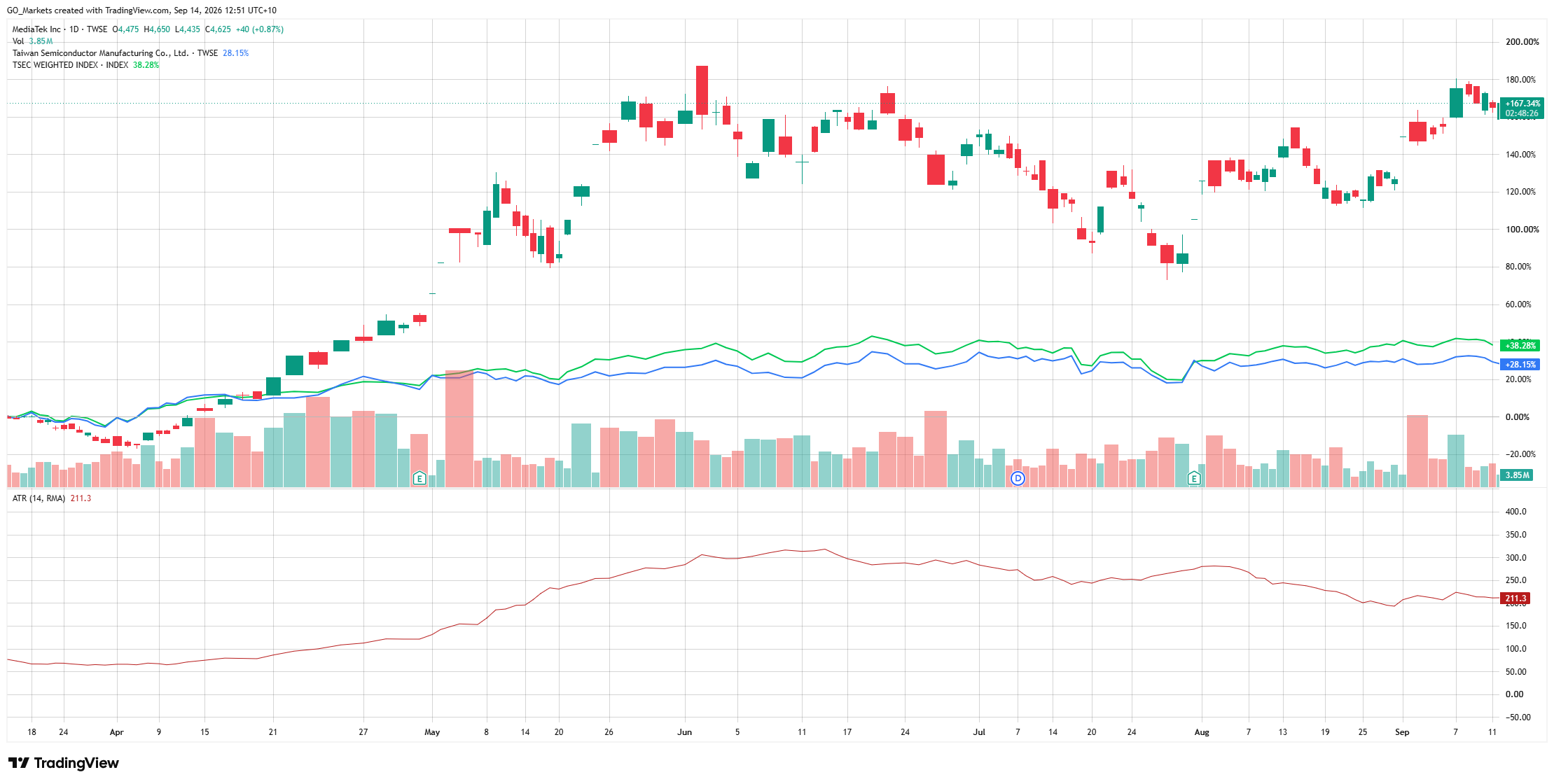
Source: Market data as at 11 September 2026.
Further progress with hyperscalers and custom AI processors could keep attention on MediaTek's data centre business.
Deploying neural processing units (NPUs) across smartphones gives MediaTek exposure to AI adoption outside data centres.
Smartphones remain a substantial part of the business; softer replacement demand could offset newer AI opportunities.
Foundry, packaging and semiconductor input costs could compress margins even if top-line demand stays robust.
Delta Electronics
AI has a power problem: Advanced GPUs are useless without electricity and cooling. Delta Electronics supplies power systems and thermal-management products for data centres, sitting directly on the physical side of the AI boom.
Rising AI computing density is increasing rack power requirements and accelerating demand for liquid cooling. Delta's portfolio includes high-voltage power systems and cooling distribution units designed for high-density workloads—a physical bottleneck where power in meets heat out.
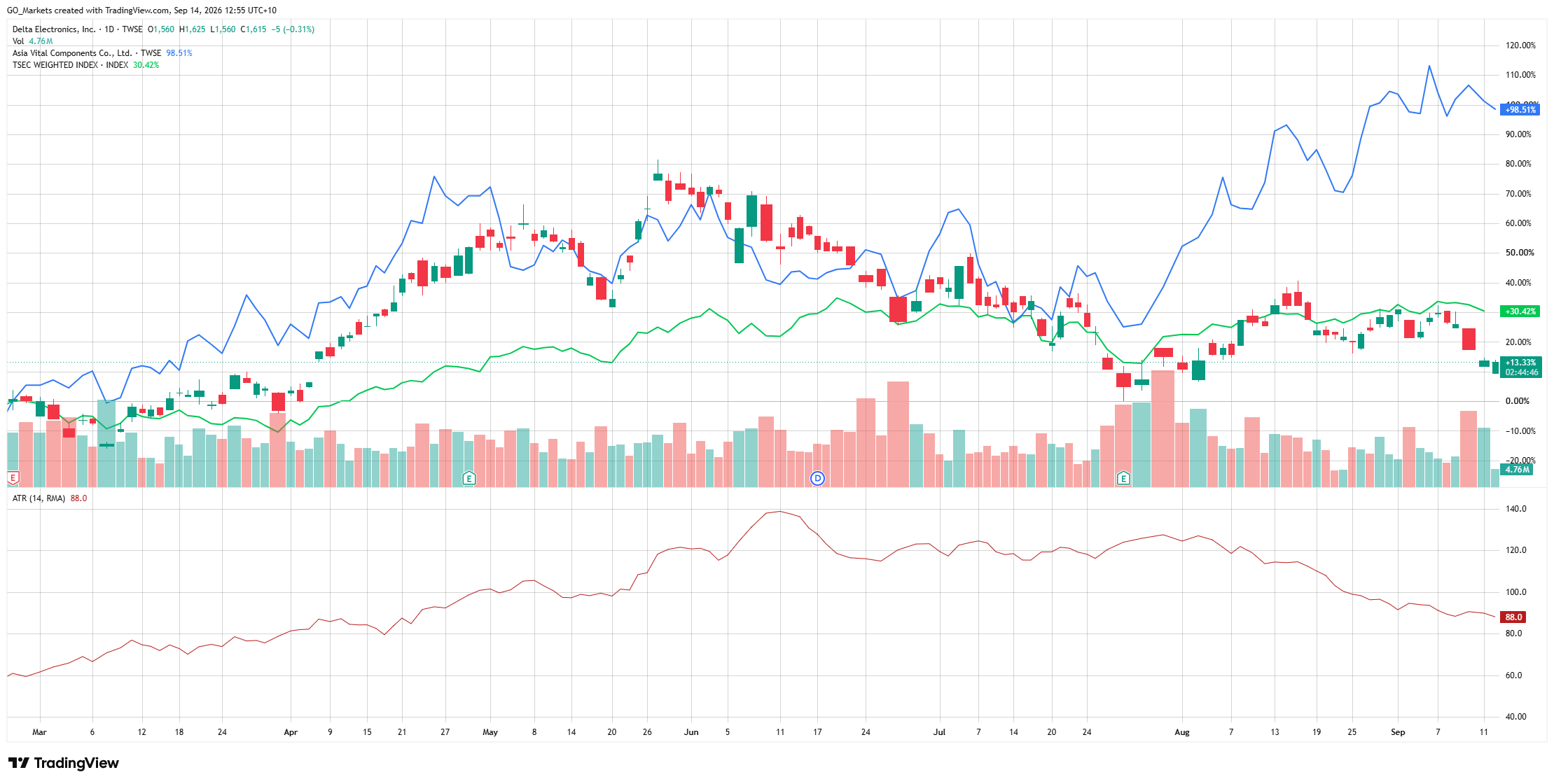
Source: Market data as at 11 September 2026.
More power-hungry computing systems support sustained demand for higher-capacity power and liquid-cooling infrastructure.
Construction, grid connection or customer rollout delays could push equipment demand further into the future.
Fluctuations in copper, aluminium and raw component costs can weigh on industrial manufacturing economics.
A slowdown in infrastructure spending impacts power and cooling suppliers alongside chipmakers.
Sanrio Co. Ltd.
No chips, just characters: Sanrio is the obvious odd one out, monetising characters, merchandise, licensing and intellectual property (IP). The company launched Sanrio Games in April as part of its strategy to become a global IP platform provider, planning 10 titles through March 2029.
Its first console title, Hello Kitty Party Land, releases on 29 October 2026 following an appearance at the Tokyo Game Show (17–21 September). Note: Sanrio completed a 5-for-1 stock split effective 1 April 2026; price references reflect post-split levels.

Source: Market data as at 11 September 2026.
Further licensing, gaming and entertainment expansion broadens how Sanrio monetises its character portfolio globally.
The October console launch of Hello Kitty Party Land provides near-term visibility around the new gaming strategy.
Merchandise sales and themed entertainment stay sensitive to discretionary household spending trends.
Reducing reliance on domestic merchandise by executing an international IP licensing model supports long-term valuation.
Trip.com Group
Travel crowds meet earnings: Trip.com represents consumer leisure demand across accommodation reservations, transportation ticketing, packaged tours and corporate travel management. Its reported Q1 2026 revenue rose 17% YoY to RMB16.2 billion.
That reporting gap closes as Trip.com publishes its Q2 and H1 2026 results on Tuesday 15 September US time (16 September HK time). The earnings release serves as a key fundamental catalyst ahead of China's autumn travel boom.
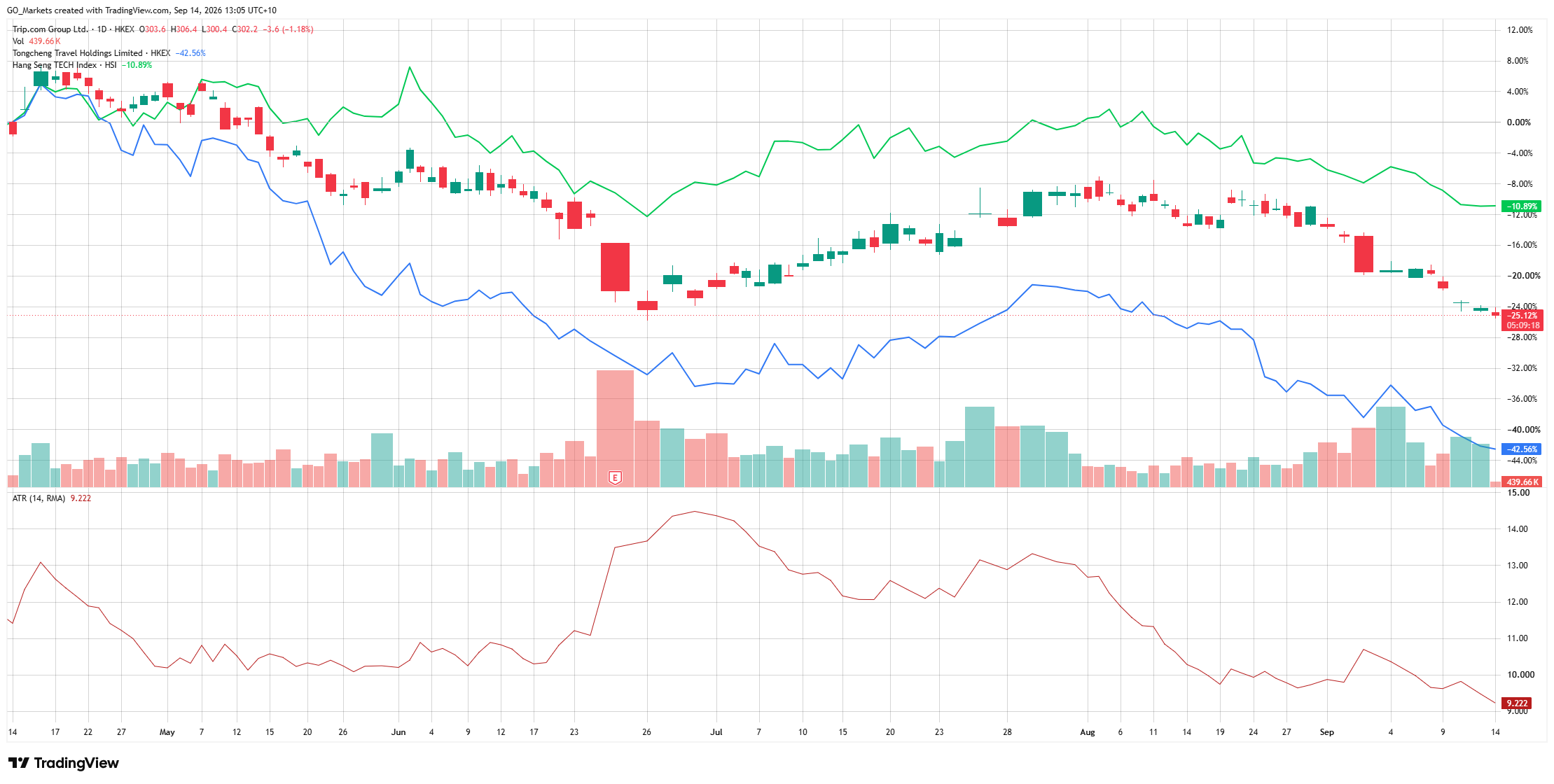
Source: Market data as at 11 September 2026.
Stronger revenue, booking margins and management commentary update the fundamental outlook ahead of holiday travel.
Higher passenger numbers do not automatically guarantee stronger profit margins if discounting remains prevalent.
Evolving airfares, fuel surcharges and airline capacity constraints influence consumer travel distance and frequency.
Consumers may maintain holiday plans while trading down to budget accommodation or shorter itineraries.
What could shift the wider Asian equity story?
These companies operate across distinct business models, but they remain interconnected through broader regional macro drivers:
- Currency dynamics: Japanese equities react sharply to yen volatility and Bank of Japan policy shifts. For Advantest, currency movements directly impact translated overseas earnings.
- AI capital expenditure cycles: Advantest, MediaTek and Delta sit at different links of the AI supply chain. A shift in hyperscaler infrastructure spending impacts testing, custom chips and thermal hardware alike.
- Trade policy and export rules: Technology transfer rules and cross-strait trade conditions remain persistent risk factors across Asian semiconductor supply chains.
- Regional market liquidity: Bank holidays across China and Hong Kong alter market depth. As explored in our guide on liquidity in trading, temporary pauses in mainland channels like Stock Connect change the participant mix during local sessions.
Bottom line
Asia is not a single trade, nor is artificial intelligence. Advantest focuses on chip testing, MediaTek expands into data centre ASICs, Delta handles power and heat, Sanrio monetises global character IP, and Trip.com tracks real-world leisure spending. Five stocks, five distinct sets of catalysts—and a clear reminder that looking underneath benchmark indices reveals where individual market opportunities actually sit.

The information provided is of general nature only and does not take into account your personal objectives, financial situations or needs. Before acting on any information provided, you should consider whether the information is suitable for you and your personal circumstances and if necessary, seek appropriate professional advice. All opinions, conclusions, forecasts or recommendations are reasonably held at the time of compilation but are subject to change without notice. Past performance is not an indication of future performance. Go Markets Pty Ltd, ABN 85 081 864 039, AFSL 254963 is a CFD issuer, and trading carries significant risks and is not suitable for everyone. You do not own or have any interest in the rights to the underlying assets. You should consider the appropriateness by reviewing our TMD, FSG, PDS and other CFD legal documents to ensure you understand the risks before you invest in CFDs. These documents are available here.
Any references to Australian or international shares, sectors, indices, ETFs, crypto-related stocks or other instruments are provided for market commentary and watchlist purposes only and do not constitute a recommendation, offer or solicitation to buy, sell or hold any financial product or adopt any investment strategy. International markets may involve additional risks, including currency fluctuations, regulatory differences, market structure differences, reduced liquidity and higher volatility. Company-specific, sector-specific and macroeconomic risks may also affect performance.
Commentary on geopolitical developments, economic data, central bank decisions, earnings, policy changes and other global or financial market events is based on information available at the time of publication and may change without notice. Such events can lead to sudden market moves, price gaps, reduced liquidity, wider spreads and increased volatility, particularly in leveraged products such as CFDs. Forward-looking statements, expectations and scenario analysis are inherently uncertain and should not be relied on as guarantees of future market behaviour or outcomes.