


From AI chipmakers requiring physical copper supply to Japanese interest rates impacting crypto leverage, here are five unexpected cross-asset connections to keep on your Q4 radar.
At first glance, copper, the Japanese yen and Bitcoin have very little reason to appear in the same article. One is a metal, one has spent decades at the centre of global funding markets, and one is a digital asset volatile enough to make gold look relatively restrained.
Yet as Q4 develops, those markets are being pulled into the same story because AI infrastructure requires enormous amounts of physical capital, Japan is making yen funding more expensive, and Bitcoin is trading against a backdrop of rising sovereign debt, deeper institutional access and changing liquidity conditions.
Each market still has its own fundamentals, but the capital moving through them does not respect those boundaries quite so neatly.
That is where the connections start to matter.
AI has a copper problem
The AI story is usually told through chips, cloud capacity and mega-cap technology stocks because Nvidia, Microsoft, Amazon, Alphabet and Meta are where investors can see the spending first.
But every new data centre eventually runs into the physical world, where electricity, transmission infrastructure, cooling systems and copper become just as important as processors.
AI is mainly a software and semiconductor story, so the most obvious way to follow the build-out is through technology companies and chipmakers.
The infrastructure behind AI has become too large to treat as background detail.
Combined 2026 capital expenditure guidance from Microsoft, Alphabet, Amazon and Meta has climbed to around US$720 billion to US$745 billion, although that spending covers broader infrastructure rather than AI alone.
%20as%20a%20%25%20of%20GDP%20against%20historic%20US%20investment%20boom.gif)
Historical context: Hyperscaler capital expenditure relative to GDP against historic US infrastructure booms. Source: Bloomberg, CEIC, US BEA, BHP Analysis.
BHP gives that spending a physical dimension, estimating that every additional US$200 billion of annual data centre investment could require copper equivalent to a new 150,000-tonne-per-year mine.
That changes the way the AI story travels through markets because when hyperscalers announce another wave of data centre investment, the question is no longer only how many chips they will buy. Investors also have to consider where the electricity will come from, how the grid will carry it and whether enough copper can be supplied to connect everything.
So while the AI boom may start on the Nasdaq, parts of the story eventually reach the commodities market, which is where the next connection begins.
The yen only matters if you trade FX
If you never trade USD/JPY or AUD/JPY, it would be reasonable to assume a Bank of Japan decision belongs in somebody else's market.
The problem is that the yen has never been only a currency. For decades, unusually low Japanese interest rates also made it a source of relatively cheap funding for investors buying higher-yielding assets elsewhere.
Japanese interest rates mainly matter to FX traders because the direct impact should be concentrated in yen currency pairs.
The Bank of Japan raised its overnight policy rate to around 1.25% in September, which changes the economics of one of the world's most established funding trades.
When Japanese borrowing costs rise, funding positions in yen become less attractive, and if the currency strengthens sharply at the same time, leveraged investors may have to hedge, reduce positions or unwind them altogether.
That is when a move that begins in Tokyo can travel into other markets, because the capital funded through yen borrowing may also be sitting in equities, commodities, digital assets or risk-sensitive currencies such as the Australian dollar.
This does not mean every yen rally triggers a global sell-off, and it certainly does not mean every Bank of Japan decision produces the same reaction. It does mean, however, that the yen sits inside the plumbing of global liquidity, so changes in the cost of that funding can reach well beyond FX.
And once liquidity enters the story, Bitcoin becomes difficult to leave out.
Bitcoin is still mainly a retail speculation story
Bitcoin built much of its reputation on retail momentum, leverage and sharp price swings. Some of that remains, but the market around it has changed.
Bitcoin remains primarily a speculative retail asset, largely separate from traditional macro forces.
Spot exchange-traded funds have widened institutional access, while Bitcoin's fixed issuance now sits against a very different fiscal backdrop.
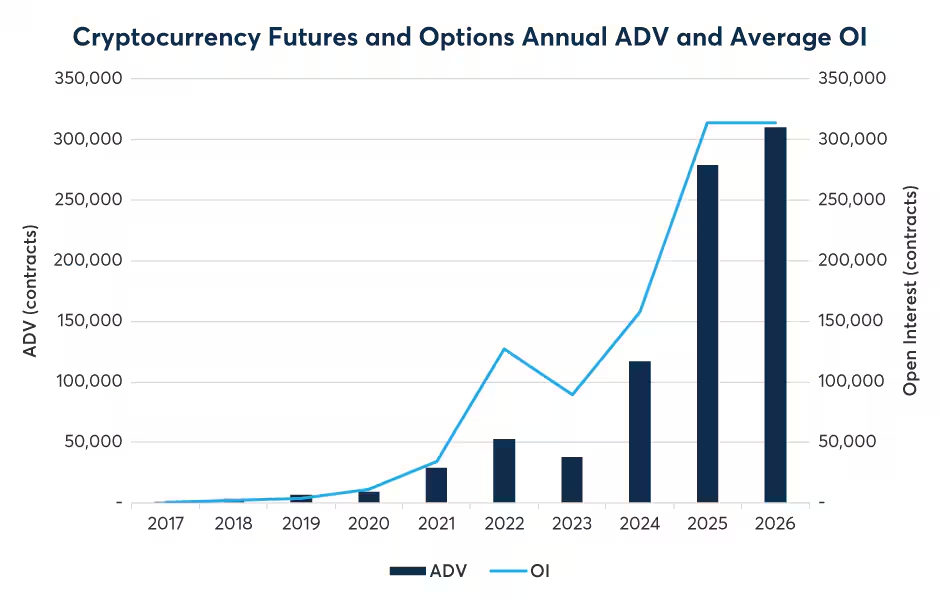
Institutional depth: Cryptocurrency futures and options annual average daily volume (ADV) and open interest (OI) expanding through 2026. Source: CME Group.
Following the 2024 halving, annual new Bitcoin issuance fell to roughly 165,000 BTC, leaving supply growth below 1%. Meanwhile, US total public debt crossed US$40 trillion in August 2026.
That does not mean rising debt automatically pushes Bitcoin higher. It does help explain why Bitcoin increasingly appears in discussions around gold, sovereign bonds and monetary policy.
But institutional access has not made Bitcoin defensive. It remains highly sensitive to leverage and liquidity, and can still fall alongside equities when risk appetite deteriorates.
That is why volatility still matters.
One market sneezes, and the others start checking the forecast
This is where the separate stories connect.
Stronger than expected US data can push Treasury yields higher, strengthen the US dollar and shift global rate differentials. That can put pressure on USD/JPY just as Japanese borrowing costs are rising.
If the yen then strengthens sharply, funds using yen financing may reduce risk, and the adjustment can spread beyond currencies.
A move in one asset class should mostly stay there. A yield move is a bond story, a yen rally is an FX story and copper is a commodity story.
Capital does not organise itself according to the tabs on a trading platform.
The same institution can hold technology shares, commodities, currencies and digital assets, so changes in funding costs or volatility can force adjustments across several markets at once.
A yield shock can move the dollar, influence the yen and alter leveraged funding positions. Those shifts may spill into growth equities and Bitcoin, while tighter financial conditions can also affect expectations for AI infrastructure spending and copper demand.
The sequence is illustrative, not predictive. Markets can break, accelerate or reverse the chain, which is exactly why the connections matter.
The Q4 market map: cross-asset transmission
Five distinct market catalysts feeding into one overarching macro reality
CapEx and infrastructure spending
Grid and electrification demand
BoJ tightening and carry-trade liquidity
Fixed supply and spot ETF access
US$40 trillion debt and funding pressure
Different assets, same capital pool. A rate, yield or liquidity shock in one market can reprice technology, commodities, currencies and digital assets at the same time.
What Q4 could reveal
The AI trade now reaches beyond software because building AI infrastructure requires power, grids and raw materials.
The yen matters beyond FX because it remains tied to global funding, while Bitcoin increasingly sits inside the traditional macro framework even though its volatility still sets it apart from more established defensive assets.
Taken together, those links make Q4 less about following one chart and more about understanding where the next move might begin.
A trader watching AI earnings may also need to understand copper. Someone following Bitcoin may need to know why Treasury yields are moving. And an AUD/JPY move may make more sense once the Bank of Japan, global liquidity and leveraged funding are viewed together.
Each market still tells its own story, but the money moving through them increasingly connects the chapters.

Disclaimer: Articles are from GO Markets analysts and contributors and are based on their independent analysis or personal experiences. Views, opinions or trading styles expressed are their own, and should not be taken as either representative of or shared by GO Markets. Advice, if any, is of a ‘general’ nature and not based on your personal objectives, financial situation or needs. Consider how appropriate the advice, if any, is to your objectives, financial situation and needs, before acting on the advice.